|
THE REVELATION OF JESUS CHRIST
'These things says He who has the seven Spirits of God and the seven stars:' - "I know your works, that you have a name that you are alive,
but you are dead." - Revelation 3:1b-e
The Counter-Reformation
Another important reason the Reformation period was "dead" was the success of the Catholic Counter-Reformation and the
failure of the new Protestants to walk in the fullness of the Holy Spirit.
Rise of the Jesuits
Most Christians have heard of the Jesuits but don't know much about them. This is especially interesting in the light of the
fact that they are now the largest order in the Catholic Church, and Pope Francis, who was recently enthroned as Pope is the first Jesuit ever
to become Pope.
Their story began with the dramatic life of Ignatius of Loyola (1491 to 1556), an aristocratic young man who became a Spanish
knight, but was seriously wounded in the Battle of Pamplona in 1521 when he was struck by a cannonball. The injury left him partially disabled,
but during his long recovery he devoted himself to serve God with a zeal that was equal to his former military discipline. He had spiritual
visions and developed an intense devotional life, from which he conceived and published "Spiritual Exercises" that would eventually be required
of all who would follow him.
Ignatius travelled to the Holy Land, and some believe he received secret information about the practices of the Knights Templar,
which had been disbanded in 1312 (F Tupper Saussy, Rulers of Evil, 1999, Ospray Bookmakers, p. 33).
He studied theology during the early days of the Spanish Inquisition and the Protestant Reformation. He became a priest, and
then, with a few disciplined followers, including Francis Xavier, who would become a missionary the to the far East, formed the "Society of
Jesus" in 1539. This organization was recognized by Pope Paul III in 1540 as a new Catholic order. Their purpose was to "do battle in the Lord
God's service under the banner of the Cross."(Saussy, ibid, p. 46) They were to counteract the effect of the Protestant Reformation. Jesuits
pledged absolute loyalty to the Pope. One of Loyola's most famous quotations is:
That we may be altogether of the same mind and in conformity with the Church herself, if she shall have defined anything to be black which
appears to our eyes to be white, we ought in like manner to pronounce it to be black.
(http://en.wikipedia.org/wiki/Ignatius_of_Loyola)
Loyola was appointed the first Superior General, with dictatorial powers over the members of the order. In this role
he was to be honored, like the Pope, as the representative of Christ. This equality with the Pope led to the unofficial title of "The Black Pope."
The emphasis of the Reformation was to return to the Bible, and to allow common people to read and study it in their own
languages. This raised serious questions about all of the un-biblical concepts that had been adopted by the church during the thousand-plus
years of the Middle Ages. From the beginning, the Society of Jesus, which began to be called "Jesuits," sought to counter biblical knowledge
with other kinds of knowledge. They became the champions of science and education. Their members, who were actually monks, were encouraged to
wear normal clothing and assume positions in all areas of influence. In essence, they became undercover agents for the Catholic Church to
discredit Protestants and bring them back into the fold of the Catholic Church.
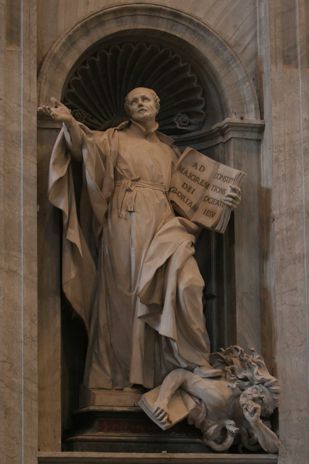
The statue of Ignatius of Loyola in St. Peter's Basilica in Rome portrays him stepping on the neck of a Protestant
(presumably Martin Luther).
Loyola died in 1556 but his successors kept building on his foundational concepts.
By the 1700's Jesuits were viewed as foreign agents in some countries. They were banned in France and Spain, and then, in 1773,
Pope Clement XIV dissolved the order. They were restored however in 1814.
(http://www.gracecentered.com/christian_forums/catholic-forum/the-extreme-oath-of-the-jesuits/)/font>
They have now grown from a small band of dedicated soldiers to the largest men's single religious order of priests and
brothers in the Catholic Church with approximately 18,000 members world-wide. They are constantly infiltrating governments, businesses, the
arts, and especially education. There are now 28 Jesuit colleges and universities in the United States and some 189 Jesuit institutions of
higher learning worldwide! (http://www.ajcunet.edu/institutions) Their students are not taught to know and revere the Bible, which would
advance the Protestant agenda, but to trust humanism, psychology, and philosophy instead.
We will return to the influence of the Jesuits in the historical portions of the last two churches in Revelation 3:
Philadelphia and Laodicea.
The Council of Trent
If the Jesuits were the undercover agents of the Counter Reformation, the Council of Trent was the visible, spectacular,
and formal declaration of war against Protestants. It was a series of meetings over a period of 18 years in various venues. It began in 1545
and concluded in 1563.
The Council reconfirmed all of the beliefs and practices that were questioned by the Protestant Reformation, and pronounced
anathemas (eternal damnations) upon anyone who believed the things the Reformers taught, which are basically the same things
that evangelical believe and teach today!
(http://www.thecounciloftrent.com/ch14.htm)
Some of the key concepts of Catholicism that were reaffirmed by the Council of Trent were:
- Works-based salvation through the sacraments and confession. Man participates in his own salvation. There was no mention of assurance
of salvation - one could die with an unconfessed mortal sin.
- Indulgences
- Purgatory
- Sacrifice of the Mass
- Transubstantiation
- Veneration of Saints/ Images
- Prayers for the dead
(Encyclopedia Britannica: Council of Trent, http://www.britannica.com/EBchecked/topic/604238/Council-of-Trent)
(Catholic Encyclopedia: Council of Trent, http://www.newadvent.org/cathen/15030c.htm)
(Catholic Encyclopedia: Prayers for the Dead, http://www.newadvent.org/cathen/04653a.htm)
The result of this Council was great persecution of Reformers and the prolonging of the Inquisitions. Whole groups of
dissenters, such as the Huguenots and Waldensians were massacred. Religious wars continued for decades in France, the Netherlands and Spain.
The "Thirty-Years War" (1618 - 1648) involved fighting between Catholics and Protestants throughout all of Europe, and is considered the
continent's most devastating war.
Need for the Fullness of the Holy Spirit
As we saw at the beginning of this verse, Jesus described Himself as "He who has the seven Spirits of God and the seven
stars." This expression was first given in chapter 1, verse 4. It was a reference to the Holy Spirit. We have already seen that
the number seven is used repeatedly in the Revelation to signify completeness and inclusiveness ("seven churches," "seven stars," etc.).
John MacArthur suggests that it might also be a reference to an Old Testament description of the Holy Spirit.
The Spirit of the LORD shall rest upon Him,
The Spirit of wisdom and understanding,
The Spirit of counsel and might,
The Spirit of knowledge and of the fear of the LORD. - Isaiah 11:1-2
MacArthur comments, "The Spirit of the Lord is described as the Spirit of wisdom and understanding, counsel, strength,
knowledge and fear, adding those six to the title Spirit of the Lord gives you the seven-fold Spirit, that would be the Holy Spirit described
in the fullness of His operation." (http://www.gty.org/resources/sermons/66-11)/font>
This gives us an insight about the biggest problem of all for the Reformation Church. In spite of their diligent study and
their courageous actions, they often failed to realize that victory in spiritual warfare depends on the power of the Holy Spirit. Spiritual
life and vitality does not come from merely knowing the truth, but from the power of the Holy Spirit literally living within us and
controlling our thoughts and actions (John 14:15-27; 16;5-15; Galatians 5:16-26; Ephesians 5:18-21; 6:10-18).
The Apostles and other early church leaders depended completely on the Holy Spirit. It has been noted by many commentators
that the Book of Acts is really a record of The Acts of the Holy Spirit. By the time of the Reformation the Church was no longer steeped in
the details of God's Word. We have no doubt that the Reformation was the work of the Holy Spirit, or that godly Christians during this period
were often led by the Spirit. However, there was little emphasis on the work of the Holy Spirit. Unfortunately this was another error that was
carried over into the Reformation Church - a dependence on self-effort instead of dependence on the Third Person of the Trinity.
When we study the next Church - Philadelphia- we will see that the missionary movement was characterized by much greater
reliance on the power of the Holy Spirit, like it will be in the future kingdom predicted by Zechariah.
"This is the word of the LORD to Zerubbabel:
'Not by might nor by power, but by My Spirit,"
Says the LORD of hosts. - Zechariah 4:6
|